

Get 4A0-113 Products Practice Material for 4A0-113 Exam Question Preparation
Most Reliable Nokia 4A0-113 Training Materials
Nokia 4A0-113 Certification Exam is a vendor-neutral certification, which means that it is not tied to any specific hardware or software platform. This makes it an attractive certification for networking professionals who want to demonstrate their expertise in OSPF and increase their career prospects.
To prepare for the Nokia 4A0-113 exam, candidates should have a solid understanding of networking fundamentals, including TCP/IP, routing protocols, and network topologies. They should also be familiar with Nokia's networking products and technologies, including the Nokia Service Router and the Nokia Network Services Platform. Candidates can use a variety of resources to prepare for the exam, including study guides, practice exams, and training courses.
NEW QUESTION # 26
Which of the following correctly lists the 5 OSPF packet types?
- A. Hello, link state update, link state packet, link State acknowledgement, database description.
- B. Hello, link state update, link state request, link state acknowledgement, database description.
- C. Hello, link state refresh, link state update, link state acknowledgement, link state authentication.
- D. Link state update, link state refresh, link state acknowledgement, database description, notification.
Answer: B
NEW QUESTION # 27
Click the exhibit button.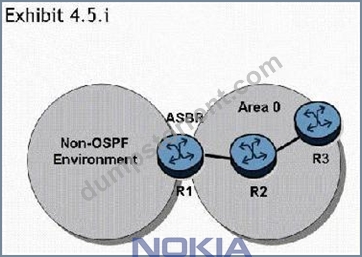
In the topology shown, router R1 is an ASBR configured to export external routes to OSPF. How many type 4 LSAs will be present in the network?
- A. One for each of the external routes exported by router R1.
- B. Type 4 LSAs are not generated in this network topology.
- C. One for each of the routers in area 0
- D. One.
Answer: B
NEW QUESTION # 28
Which of the following statements regarding OSPF routing updates on a multi-access network segment is true?
- A. In multi-access networks, a DR and BDR are elected only if the subnet masks on the router interfaces are less than /30
- B. In multi-access networks, a DR and BDR are elected only if there are more than two routers connected to the network segment.
- C. In multi-access networks, a DR and BDR are elected. The DR sends link-state advertisements describing the network.
- D. In multi-access networks, a DR and BDR are elected. To ensure resiliency, both the DR and BDR send link-state advertisements describing the network.
Answer: C
NEW QUESTION # 29
Click the exhibit button.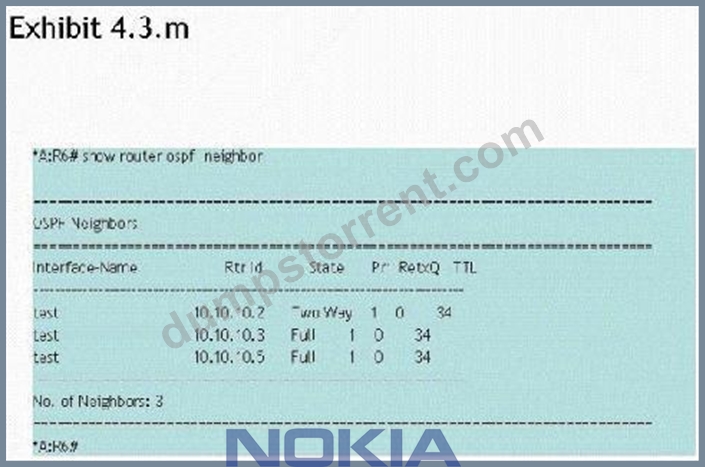
What can you deduce from the show command on router R6?
- A. The router R6 interface is in a multi-access segment. It is neither the DR nor the BDR for the segment.
The DR for this segment would be the router with router ID 10.10.10.5. - B. The router R6 interface is in a multi-access segment. It is the BDR, which is why it is not adjacent to the other routers.
- C. The router R6 interface is in a multi-access segment. It is neither the DR nor the BDR for the segment.The DR for this segment would be the router with router ID 10.10.10.3.
- D. The router R6 interface is in a multi-access segment. It is neither the DR nor the BDR for the segment; however, this command does not indicate whether 10.10.10.3 or 10.10.10.5 is the DR or BDR.
Answer: D
Explanation:
Comprehensive and Detailed Explanation From Exact Extract:
According to Nokia 7750 SR OS Routing Protocols Guide (OSPF Neighbor States and DR Election):
"A router with multiple neighbors in 2-Way state on a multi-access segment indicates that it is neither DR nor BDR. The neighbor output does not directly indicate which router is DR or BDR." In the exhibit, R6 sees neighbors 10.10.10.2 in 2-Way state and 10.10.10.3, 10.10.10.5 in Full state.
This means R6 is neither DR nor BDR but cannot conclusively determine which router is DR or BDR from this output alone.
Therefore, correct answer is B.
NEW QUESTION # 30
How many databases does a Link State routing protocol use?
- A. One
- B. Four
- C. Two
- D. Three
Answer: D
NEW QUESTION # 31
Click the exhibit button.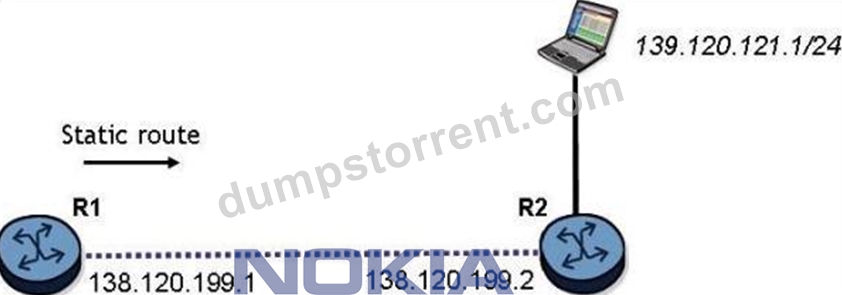
What is the command to configure a static route on the Nokia 7750 SR router R1 to reach the network behind router R2?
- A. configure router static-route 138.120.199.2/24 next-hop 138.120.199.1
- B. configure router static-route 139.120.121.0/24 next-hop 138.120.199.1
- C. configure router static-route 139.120.121.0/24 next-hop 138.120.199.2
- D. configure router static-route 139.120.121.0/24 next-hop 139.120.121.2
Answer: C
NEW QUESTION # 32
What command could be used to verify proper configuration of a static route in an Nokia 7750 SR router?
- A. Show router routing-table
- B. Show router route-table
- C. Show route-table
- D. Show static
Answer: B
Explanation:
Comprehensive and Detailed Explanation From Exact Extract:
From Nokia 7750 SR OS Routing Protocols Guide (Static Route Verification):
"The 'show router route-table' command displays the entire routing table, including static routes, dynamic routes, and directly connected routes." Correct syntax:
show router route-table
Thus, correct answer is C.
-
NEW QUESTION # 33
What is the default preference value for a static route in the Nokia 7750 SR?
- A. 0
- B. 1
- C. 2
- D. 3
Answer: D
NEW QUESTION # 34
What must be configured on the Nokia 7750 SR for RIP to advertise locally attached links?
- A. A policy statement within the router identifying what is to be advertised
- B. Access-lists denoting what is to be advertised
- C. Default metrics for each link
- D. A group and neighbor statement for each peer
Answer: A
NEW QUESTION # 35
What are some of the characteristics of Nokia's implementation of non-stop routing? (Choose two)
- A. Only supported by OSPF and IS-IS
- B. No protocol extensions required
- C. Uses Graceful Restart to inter-operate with other vendors
- D. Transparent to routing neighbors
Answer: B,D
NEW QUESTION # 36
What are the three databases maintained by a Link State Protocol?
- A. Neighbor, topology, forwarding
- B. There are only two databases: adjacency and topology
- C. Topology, routing, forwarding
- D. Neighbor, adjacency, route table
Answer: A
Explanation:
Comprehensive and Detailed Explanation From Exact Extract:
From Nokia 7750 SR OS Routing Protocols Guide (Link State Protocol Architecture):
Link state protocols (OSPF, IS-IS) maintain:
Neighbor (adjacency) database # tracks neighbors and adjacencies
Topology (Link State) database # entire area topology
Routing (Forwarding Information Base) derived from SPF calculations
Thus, correct answer is B.
NEW QUESTION # 37
Click the exhibit button.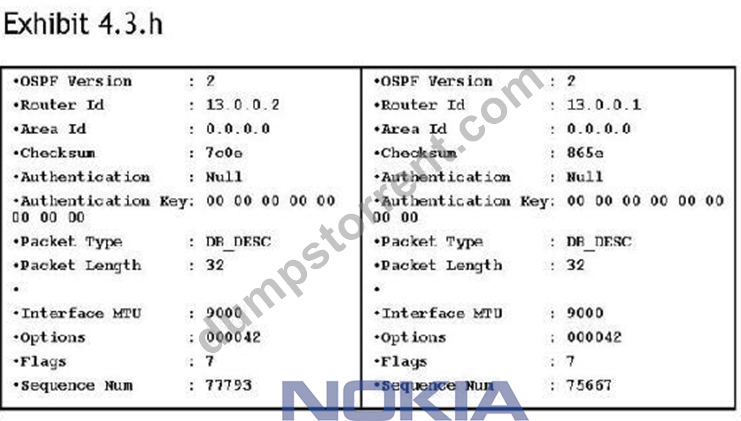
The OSPF packets shown have been exchanged between two neighbors. What state is the OSPF adjacency in?
- A. The adjacency state is two way because both routers have received a database description packet.
- B. The adjacency is in the exchange state. The next step is to exchange link state request and link state update packets.
- C. The adjacency is in the ex start state. The routers have exchanged database description packets, but still have to negotiate the starting sequence number.
- D. The adjacency state is full. The routers are exchanging database description packets to notify each other that all link state advertisements have been received.
Answer: C
NEW QUESTION # 38
Which of the following commands can be used to display the number of SPF computations that have been performed on a router?
- A. show router ospf area <area-id>
- B. show router ospf interface
- C. show router ospf status
- D. show router ospf neighbor
Answer: A
NEW QUESTION # 39
Click the exhibit button.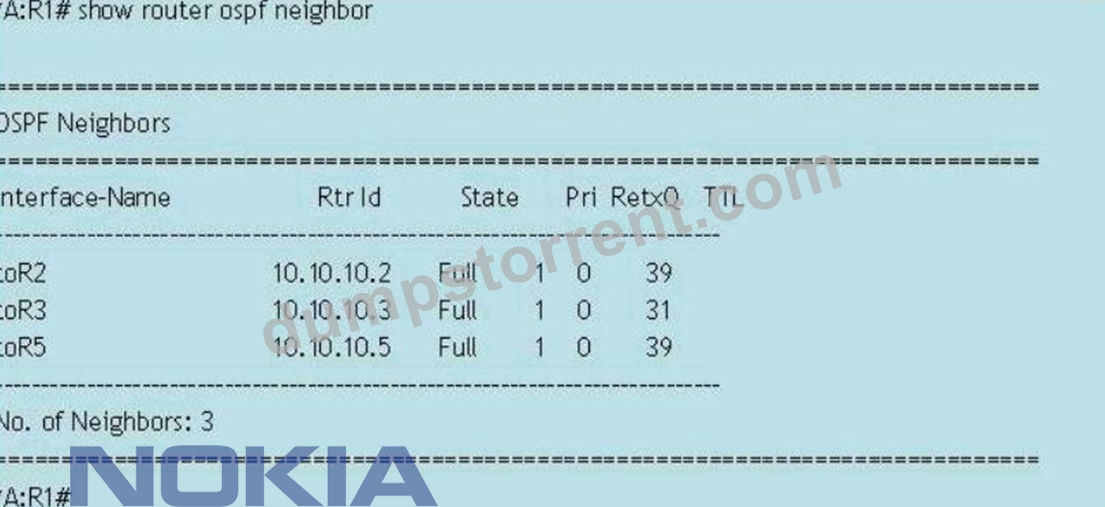
The following command sequence is executed on router R2:
- A. R2# configure router ospf router-id 10.10.10.99
- B. R2# configure router router-id 10.10.10.66
On router R1, what router ID appears for router R2 directly after these commands are executed? - C. 10.10.10.1
- D. 10.10.10.2
- E. 10.10.10.99
- F. 10.10.10.66
Answer: A
Explanation:
Comprehensive and Detailed Explanation From Exact Extract:
From Nokia 7750 SR OS Routing Protocols Guide (Router ID Selection):
"The OSPF router ID configured under the OSPF context overrides the global router ID configured under the general router context." Since "configure router ospf router-id 10.10.10.99" was applied, this takes precedence for OSPF operation, even though "configure router router-id 10.10.10.66" was configured globally.
Thus, router R1 will see router R2's OSPF router ID as 10.10.10.99.
-
NEW QUESTION # 40
Click the exhibit button.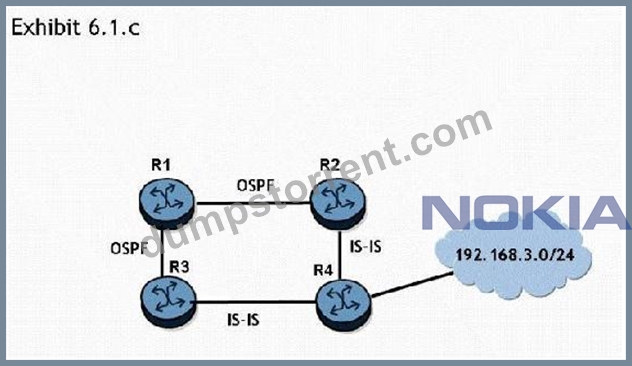
If router R2 redistributes the IS-IS route to 192.168.3.0/24 into OSPF, router R3 preference of these two routes? Choose two answers.
- A. The OSPF internal preference
- B. The OSPF external preference
- C. The IS-IS Level 1 internal preference
- D. The IS-IS Level 2 external preference
- E. The IS-IS Level 2 internal preference
- F. The IS-IS Level 1 external preference
Answer: B,C
Explanation:
Comprehensive and Detailed Explanation From Exact Extract:
From Nokia 7750 SR OS Routing Protocols Guide (Route Preferences - Default Administrative Distances):
IS-IS Level 1 internal preference: 18
OSPF external (Type 5) preference: 150
R3 will have both routes:
B (Correct): IS-IS Level 1 internal route received directly from IS-IS (lower preference value 18).
D (Correct): OSPF external route received via redistribution (higher preference value 150).
Since IS-IS internal has better preference, it will be installed, but both exist as valid route types.
-
NEW QUESTION # 41
A static route is created using the command "static-route 2.3.4.0/24 next-hop 1.2.3.4". What is the correct traceroute command to test this static route on an Nokia 7750 SR?
- A. traceroute 2.3.4.0/24 next-hop 1.2.3.4
- B. traceroute 2.3.4.1
- C. traceroute does not work on the Nokia 7750 SR
- D. traceroute next-hop 1.2.3.4
Answer: B
NEW QUESTION # 42
Which of the following correctly lists the 5 OSPF packet types?
- A. Hello, link state update, link state packet, link state acknowledgement, database description.
- B. Hello, link state update, link state request, link state acknowledgement, database description.
- C. Hello, link state refresh, link state update, link state acknowledgement, link state authentication.
- D. Link state update, link state refresh, link state acknowledgement, database description, notification.
Answer: B
Explanation:
Comprehensive and Detailed Explanation From Exact Extract:
FromNokia 7750 SR OS OSPF Guide - OSPF Packet Formats Section:
"The five OSPF packet types are: Hello, Database Description, Link State Request, Link State Update, Link State Acknowledgement." Thus, the correct list is:
Hello
Database Description
Link State Request
Link State Update
Link State Acknowledgement
Which corresponds to option D.
NEW QUESTION # 43
What is the default preference value for a static route in the Nokia 7750 SR router?
- A. 0
- B. 1
- C. 2
- D. 3
Answer: D
NEW QUESTION # 44
Which of the following statements regarding area border routers in an OSPF network is true?
- A. By definition, an area border router must perform route summarization between areas.
- B. An OSPF network needs at least one area border router to function.
- C. Area border routers connect the backbone area to other areas in an OSPF network.
- D. The term backbone router has the same definition as the term area border router.
Answer: C
Explanation:
Comprehensive and Detailed Explanation From Exact Extract:
FromNokia 7750 SR OS OSPF Guide - Area Border Routers (ABRs) Section:
"An ABR is a router connected to both area 0 and at least one non-backbone area, responsible for exchanging routing information between areas." ABRs serve as gateways between the backbone area (area 0) and non-backbone areas.
Summarization is optional on ABRs, not mandatory.
Thus, the correct answer is C.
NEW QUESTION # 45
Click the exhibit button.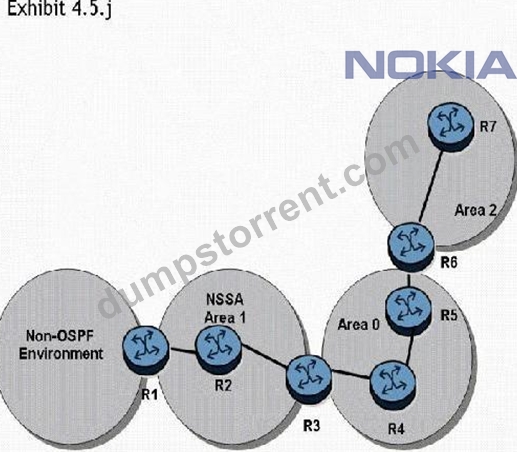
In the topology shown, router R1 is an ASBR configured to export external routes to OSPF. Which of the following statements regarding the OSPF LSAs in the network is true?
- A. Router R1 generates a type 5 LSA that is flooded through all OSPF areas.
- B. Router R1 generates a type 7 LSA that is flooded through all OSPF areas.
- C. Router R1 generates a type 5 LSA that is flooded through area 1. Router R2 generates a type 7 LSA that is flooded through areas 0 and 2.
- D. Router R1 generates a type 7 LSA that is flooded through area 1. Router R3 generates a type 5 LSA that is flooded through areas 0 and 2.
Answer: D
NEW QUESTION # 46
Which of the following statements best describes the function of an OSPF Type 4 LSA?
- A. A Type 4 LSA is originated by an ABR that is connected to a stub area. The LSA is injected into the backbone area to provide routing information.
- B. A Type 4 LSA is originated by an ABR that is connected to a stub area. The LSA is injected into the stub area to provide routing information.
- C. A Type 4 LSA is originated by an ABR to describe a route to an ASBR to routers outside the area.
- D. A Type 4 LSA is originated by an ASBR to describe a route to itself to routers outside the area.
Answer: C
Explanation:
Comprehensive and Detailed Explanation From Exact Extract:
From Nokia 7750 SR OS Routing Protocols Guide (OSPF ASBR Summary LSA):
Type 4 LSAs (ASBR Summary LSAs) are originated by ABRs.
They inform routers in other areas about how to reach the ASBR (not about external prefixes, but about the ASBR's router ID).
Thus, correct answer: A.
-
NEW QUESTION # 47
When redistributing OSPF into RIP V2 what must be taken into consideration for the redistribution to take place?
- A. The subnet mask must be removed from the OSPF route
- B. You must divide the cost of the OSPF route by three
- C. The router must be configured as an ASBR
- D. The metric must be set accordingly for RIP
Answer: D
NEW QUESTION # 48
The Nokia 7750 SR supports which two of the OSPF area types below?
- A. Partially Stubby Areas
- B. Level 1 Areas
- C. Not So Stubby Areas
- D. Stub Areas
Answer: C,D
Explanation:
Comprehensive and Detailed Explanation From Exact Extract:
From Nokia 7750 SR OS Routing Protocols Guide (Supported OSPF Area Types):
A: NSSA (Not So Stubby Area) - Supported.
C: Stub Areas - Supported.
B: Level 1 Areas - IS-IS concept, not OSPF.
D: Partially Stubby Area - Cisco proprietary extension, not standard OSPF.
Thus, correct answers: A, C.
NEW QUESTION # 49
......
LATEST 4A0-113 Exam Practice Material: https://examsboost.dumpstorrent.com/4A0-113-exam-prep.html