

Get Prepared for Your 100-490 Exam With Actual Cisco Study Guide!
Pass Your Next 100-490 Certification Exam Easily & Hassle Free
Cisco 100-490 certification exam is a valuable credential that demonstrates the candidates' proficiency in supporting and maintaining Cisco routing and switching network devices. 100-490 exam covers a range of topics, from network fundamentals to WAN technologies, and is an excellent way for network professionals to enhance their skills and knowledge. Passing 100-490 exam and earning the Cisco Certified Technician Routing and Switching certification is a great way to advance your career in the networking industry.
Cisco 100-490 certification exam is designed for network professionals who want to validate their skills in supporting Cisco routing and switching network devices. 100-490 exam covers a range of topics, including network fundamentals, network access, IP connectivity, IP services, security fundamentals, and automation and programmability. Participants who pass the exam will earn the Cisco Certified Technician Routing and Switching (CCT Routing and Switching) certification.
Cisco 100-490 exam is a part of the Cisco Certified Technician Routing and Switching (CCT R&S) certification. Supporting Cisco Routing and Switching Network Devices certification is ideal for individuals who perform onsite support and maintenance of Cisco networking devices. Supporting Cisco Routing and Switching Network Devices certification validates the knowledge and skills required to diagnose, restore, repair, and replace critical Cisco networking and system devices at the customer's site.
NEW QUESTION # 24
Refer to the exhibit.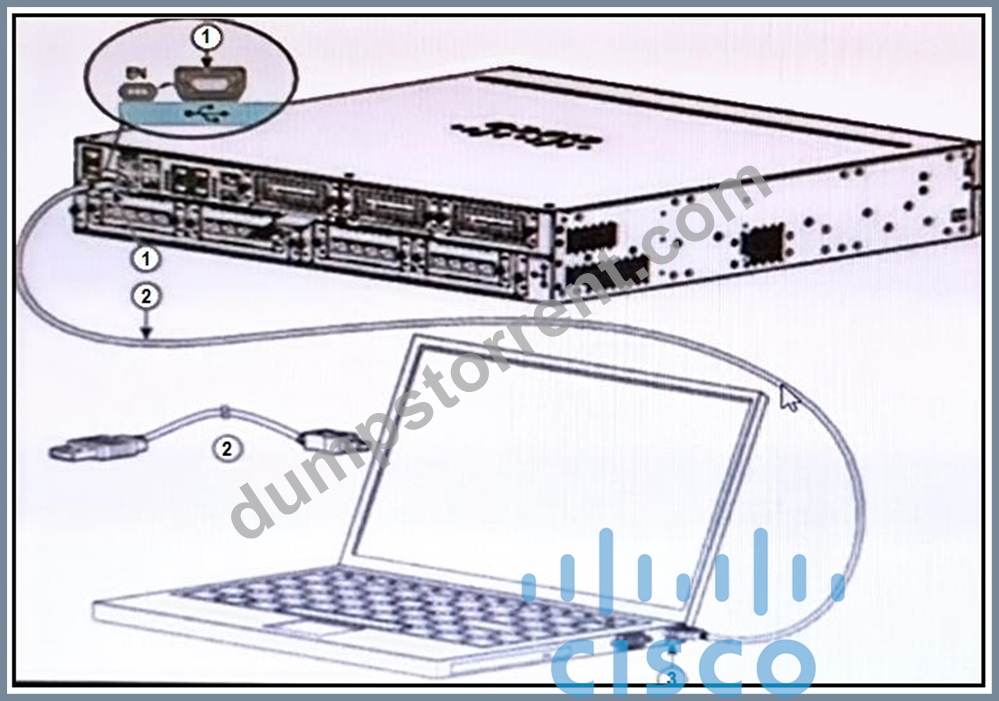
Which two statements about the hardware components are true? (Choose two.)
- A. 1 is a USB Type A port.
- B. 2 is an RJ-45 to USB Type A console cable.
- C. 2 is a USB 5-pin mini USB Type B to USB Type A console cable.
- D. 3 is a USB Type A port.
- E. 3 is a USB 5-pin mini USB Type B port.
Answer: C,E
Explanation:
The image provided shows a networking device connected to a laptop via a console cable. Based on the visual indicators and standard port designs:
C . 3 is a USB 5-pin mini USB Type B port: The port labeled "3" on the laptop is smaller than a standard USB Type A port, which suggests it is a mini USB Type B port, commonly used for connecting to networking devices for console access.
E . 2 is a USB 5-pin mini USB Type B to USB Type A console cable: The cable labeled "2" has one end that fits into the mini USB Type B port on the laptop (as identified in point 1), and the other end, which is not clearly visible in the image, is inferred to be a USB Type A connector that would typically connect to a computer's USB port.
NEW QUESTION # 25
Which two statements about Telnet and SSH are true? (Choose two.)
- A. SSH uses the well-known TCP port 23 for its communication.
- B. Telnet is preferred over SSH for security reasons.
- C. A Telnet network management connection is dropped when a router reboots.
- D. Telnet is a protocol that provides a secure remote access connection to network devices.
- E. SSH is a protocol that provides a secure remote access connection to network devices.
Answer: C,E
Explanation:
A . Correct. SSH, or Secure Shell, is indeed a protocol that provides a secure remote access connection to network devices. It encrypts the data to ensure secure transmission over insecure networks like the internet1.
C . Correct. Telnet connections are not secure and are terminated when a router reboots. This is because Telnet does not have any mechanism to maintain the connection in case of network interruptions or device reboots1.
B, D, and E are incorrect because: B. SSH uses TCP port 22 by default, not port 23, which is used by Telnet1. D . Telnet does not provide a secure connection; it transmits data in plain text, which can be intercepted easily1. E. SSH is preferred over Telnet for security reasons because it provides encrypted connections and authentication mechanisms, which Telnet does not1.
Reference :=
1: GeeksforGeeks - Difference between SSH and Telnet 2: phoenixNAP - Telnet vs. SSH: How Is SSH Different From Telnet? 3: Guru99 - Telnet vs SSH - Difference Between Them 4: Difference Between - Difference Between Telnet and SSH
NEW QUESTION # 26
From a Windows command prompt, which command displays the local IP address of a computer?
- A. ip config
- B. ipconfig
- C. ipconfiguration
- D. ip configuration
Answer: B
Explanation:
The ipconfig command in Windows is used to display and manage network configuration information for the local computer. Here's what it shows:
IP Address: The IPv4 address assigned to each network adapter.
Subnet Mask: The subnet mask used to determine the network segment.
Default Gateway: The IP address of the router used to send traffic to other networks.
Other Information: DNS servers, DHCP server details, and more.
Incorrect options:
ipconfiguration: This is not a recognized command in the Windows command prompt.
ip configuration: This is also not a recognized command.
ip config: While it might seem like it should work, Windows uses ipconfig without spaces.
How to use ipconfig:
Open the Windows command prompt (Search for 'cmd')
Type ipconfig and press Enter.
Reference:
Microsoft documentation on ipconfig: https://learn.microsoft.com/en-us/windows-server/administration/windows-commands/ipconfig
NEW QUESTION # 27
Which device is a DTE device?
- A. CSU/DSU
- B. DSL modem
- C. router
- D. cable modem
Answer: C
NEW QUESTION # 28
Which type of memory stores the configuration of a router or switch by default?
- A. flash
- B. RAM
- C. ROM
- D. NVRAM
Answer: D
Explanation:
NVRAM (Non-Volatile Random Access Memory) is the default storage location for the startup configuration file of a Cisco router or switch.expand_more Here's why:
Non-Volatility: NVRAM retains its contents even when the device loses power.expand_more This is essential for storing the startup configuration, which contains critical settings like interface configurations, routing protocols, and passwords.
Read/Write Capability: Unlike ROM, NVRAM allows you to both read and write data. This makes it possible to modify the configuration and save the changes into NVRAM as the startup configuration.
Other Memory Types and Their Functions:
RAM (Random Access Memory): RAM is volatile memory, meaning it loses its contents when the device is powered off.expand_more It's used to store the running configuration (currently active configuration), routing tables, and other temporary data required for the device's operation.
ROM (Read-Only Memory): ROM is non-volatile and stores the bootstrap program used to initiate the boot process of the device.expand_more It's not modifiable by the user.expand_more Flash: Flash memory is also non-volatile.expand_more It's primarily used to store the Cisco IOS image (operating system) and can also store backup configuration files and other data.
NEW QUESTION # 29
Which bits represent the boot field in the configuration register value?
- A. highest four bits
- B. lowest two bits
- C. highest two bits
- D. lowest four bits
Answer: D
Explanation:
The configuration register on Cisco devices is a 16-bit value, typically represented in hexadecimal notation (e.g., 0x2102). The lowest four bits (bits 0-3) of this value are designated as the boot field.
The Boot Field's Importance:
The boot field determines how the device will load its operating system (Cisco IOS) during the startup process. Here's a basic breakdown of common boot field values:
0x0: Stay at the ROMmon prompt.
0x1: Boot from ROM (often used for troubleshooting or recovery).
0x2 - 0xF: Load the operating system based on settings in the startup configuration (NVRAM) or from a network server if specified.
Example:
A configuration register value of 0x2102 indicates that the boot field is 0x2 (the last digit). This is a common default setting, instructing the device to load the Cisco IOS image from Flash memory.
Reference:
Cisco Configuration Register Detailed Explanation: [invalid URL removed] Configuration Register Settings (Cisco): https://networklessons.com/cisco/ccna-routing-switching-icnd1-100-105/configuration-register-cisco-ios
NEW QUESTION # 30
What is the default operating mode when you initially log in to a router?
- A. privileged EXEC
- B. ROM monitor
- C. global configuration
- D. user EXEC
Answer: D
Explanation:
Section: Cisco IOS Software Operation
NEW QUESTION # 31
How are IPv6 addresses notated?
- A. 2001:0DB8::/128
- B. 2001:ODB8::1:1:1:1:1
- C. 2001:0DB8:0::
- D. 2001:0DB8:130F:0000:0000:7000:0000:140B
Answer: D
Explanation:
IPv6 addresses are 128 bits in length and are written as eight groups of four hexadecimal digits. Each group is separated from the others by colons (:). The correct notation for IPv6 addresses allows for the omission of leading zeros within each block of four hexadecimal digits and the use of double colons (::) to represent consecutive blocks of zeros. However, the double colons can only be used once in an address to ensure proper expansion to the full 128 bits. Option B is the only choice that correctly represents a full IPv6 address without any abbreviation. Options A and C use double colons incorrectly, and option D represents a prefix length rather than a full address. Reference := The information is based on standard IPv6 address notation practices, which include the representation of addresses in hexadecimal format and the rules for abbreviating zeros1
NEW QUESTION # 32
Which two pairs of LAN Ethernet devices use an RJ-45 straight-through cable? (Choose two.)
- A. switch-to-hub
- B. switch-to-switch
- C. router-to-router
- D. switch-to-server
- E. switch-to-router
Answer: D,E
NEW QUESTION # 33
Which command provides detailed information about the components that are installed on a router, such as the model, PID, and serial number?
- A. show items
- B. show router
- C. show inventory
- D. show chassis
Answer: C
Explanation:
The show inventory command in Cisco IOS is designed specifically to display detailed hardware inventory information about a Cisco device. This includes:
Component Name: The name or type of each module or card installed.
PID (Product ID): The unique product identifier for the module.
VID (Version ID): The version identifier for the module.
Serial Number: The unique serial number assigned to the module.
Why other options are incorrect:
show chassis: Some Cisco devices support a show chassis command, but the information provided usually focuses on the physical chassis rather than detailed component inventory.
show items: This is not a standard Cisco IOS command.
show router: This command doesn't provide the level of granular hardware information that show inventory does.
NEW QUESTION # 34
Which Xmodem option is used to enhance error checking of an image that is copied to flash memory?
- A. -r
- B. -x
- C. -e
- D. -c
Answer: D
Explanation:
The -c option in Xmodem file transfers is used to enable CRC (Cyclic Redundancy Check) for enhanced error checking. Here's why it's the correct answer:
Error Detection: CRC is a more robust error detection mechanism compared to the standard checksum method used in Xmodem. It provides greater reliability in identifying file corruption during the transfer.
Flash Memory: Since flash memory on a Cisco router or switch stores critical data like configuration files or the IOS image, ensuring the integrity of transferred files is crucial.
Why other options are incorrect:
-e, -r, -x: These are not standard Xmodem options for error checking purposes. While some implementations may have custom flags, they are not universally applicable.
Important Note: Xmodem is a legacy protocol that is often replaced by more reliable options like TFTP in modern Cisco devices. However, understanding Xmodem options is still relevant for certain cases or older equipment.
Reference:
Xmodem overview: https://en.wikipedia.org/wiki/XMODEM
Cyclic Redundancy Check (CRC): https://en.wikipedia.org/wiki/Cyclic_redundancy_check
NEW QUESTION # 35
Which command initiates the copying of a Cisco IOS image to a Cisco device?
- A. copy tftp nvram
- B. copy tftp flash
- C. copy flash tftp
- D. copy xmodem flash
Answer: B
Explanation:
Section: Service-related Knowledge
Explanation
NEW QUESTION # 36
Which type of port is used to connect a laptop to an Ethernet port on a Cisco router?
- A. crossover
- B. straight-through
- C. rollover
- D. fiber
Answer: B
Explanation:
Straight-through cables are the most common type of Ethernet cable. They're used to connect dissimilar devices, such as a laptop to a router or a switch to a router. The internal wiring of the cable connects the transmit pins on one end to the receive pins on the other end, and vice versa.
Crossover cables were historically necessary to connect similar devices (e.g., router to router, or switch to switch). Modern devices often have auto MDI-X capabilities, allowing them to automatically detect and adjust to straight-through or crossover connections as needed.
Rollover cables have a reversed pinout and are primarily used for console access into Cisco routers and switches.
Fiber cables use fiber optic technology for high-speed, long-distance connectivity.
Reference:
Cisco Networking Academy: Introduction to Networks Course
NEW QUESTION # 37
What is the correct IPv6 address notation?
- A. 2001:0DB8::/128
- B. 2001:0DB8::1:1:1:1:1
- C. 2001:0DB8:0::
- D. 2001:0DB8:130F:0000:0000:7000:0000:140B
Answer: D
NEW QUESTION # 38
Which command provides detailed information about the components that are installed on a router, such as the model, PID, and serial number?
- A. show items
- B. show router
- C. show inventory
- D. show chassis
Answer: C
NEW QUESTION # 39
Which type of memory is used to permanently store Cisco IOS Software?
- A. SRAM
- B. flash
- C. DRAM
- D. NVRAM
Answer: D
Explanation:
Section: Cisco IOS Software Operation
NEW QUESTION # 40
......
Ace 100-490 Certification with 74 Actual Questions: https://examsboost.dumpstorrent.com/100-490-exam-prep.html