

Real CRISC Exam PDF Test Engine Practice Test Questions
ISACA CRISC Real 2023 Braindumps Mock Exam Dumps
Certification Path
The Certified in Risk and Information Systems Control Certification includes only one CRISC exams.
NEW QUESTION 287
Which of the following provides the BEST measurement of an organization's risk management maturity level?
- A. Level of residual risk
- B. IT alignment to business objectives
- C. Key risk indicators (KRIs)
- D. The results of a gap analysis
Answer: B
NEW QUESTION 288
Which of the following is MOST appropriate to prevent unauthorized retrieval of confidential information stored in a business application system?
- A. Apply single sign-on for access control.
- B. Enforce the use of digital signatures.
- C. Enforce an internal data access policy.
- D. Implement segregation of duties.
Answer: D
NEW QUESTION 289
You work as a project manager for TechSoft Inc. You are working with the project stakeholders on the qualitative risk analysis process in your project. You have used all the tools to the qualitative risk analysis process in your project. Which of the following techniques is NOT used as a tool in qualitative risk analysis process?
- A. Risk Reassessment
- B. Risk Urgency Assessment
- C. Risk Categorization
- D. Risk Data Quality Assessment
Answer: A
Explanation:
Section: Volume D
Explanation:
You will not need the Risk Reassessment technique to perform qualitative risk analysis. It is one of the techniques used to monitor and control risks.
Incorrect Answers:
A, C, D: The tools and techniques for Qualitative Risk Analysis process are as follows:
* Risk Probability and Impact Assessment: Risk probability assessment investigates the chances of a particular risk to occur.
* Risk Impact Assessment investigates the possible effects on the project objectives such as cost, quality, schedule, or performance, including positive opportunities and negative threats.
* Probability and Impact Matrix: Estimation of risk's consequence and priority for awareness is conducted by using a look-up table or the probability and impact matrix. This matrix specifies the mixture of probability and impact that directs to rating the risks as low, moderate, or high priority.
* Risk Data Quality Assessment: Investigation of quality of risk data is a technique to calculate the degree to which the data about risks are useful for risk management.
* Risk Categorization: Risks to the projects can be categorized by sources of risk, the area of project affected and other valuable types to decide the areas of the project most exposed to the effects of uncertainty.
* Risk Urgency Assessment: Risks that requires near-term responses are considered more urgent to address.
* Expert Judgment: It is required to categorize the probability and impact of each risk to determine its location in the matrix.
NEW QUESTION 290
Which of the following is the MOST important use of KRIs?
- A. Providing an early warning signal
- B. is incorrect. This is not as important as giving early warning. Answer: A is incorrect. This is one of the important functions of KRIs which can help management
to improve but is not as important as giving early warning. - C. Providing an indication of the enterprise's risk appetite and tolerance
- D. Enabling the documentation and analysis of trends
- E. Explanation:
Key Risk Indicators are the prime monitoring indicators of the enterprise. KRIs are highly relevant and possess a high probability of predicting or indicating important risk. KRIs help in avoiding excessively large number of risk indicators to manage and report that a large enterprise may have. As KRIs are the indicators of risk, hence its most important function is to effectively give an early warning signal that a high risk is emerging to enable management to take proactive action before the risk actually becomes a loss. - F. Providing a backward-looking view on risk events that have occurred
Answer: A
Explanation:
is incorrect. KRIs provide an indication of the enterprise's risk appetite and tolerance
through metric setting, but this is not as important as giving early warning.
NEW QUESTION 291
Which of the following is the MAIN reason for analyzing risk scenarios?
- A. Identifying additional risk scenarios
- B. Assessing loss expectancy
- C. Updating the heat map
- D. Establishing a risk appetite
Answer: A
Explanation:
Section: Volume D
NEW QUESTION 292
Which of the following is the BEST way for a risk practitioner to help management prioritize risk response?
- A. Explain risk details to management.
- B. Assess risk against business objectives.
- C. Implement an organization-specific risk taxonomy.
- D. Align business objectives to the risk profile.
Answer: D
Explanation:
Section: Volume D
NEW QUESTION 293
After a high-profile systems breach at an organization s key vendor, the vendor has implemented additional mitigating controls. The vendor has voluntarily shared the following set of assessments:
After a high-profile systems breach at an organization s key vendor, the vendor has implemented additional mitigating controls. The vendor has voluntarily shared the following set of assessments:
Which of the assessments provides the MOST reliable input to evaluate residual risk in the vendor's control environment?
- A. Vendor performance scorecard
- B. Internal audit
- C. Regulatory examination
- D. External audit
Answer: B
NEW QUESTION 294
The BEST way to determine the likelihood of a system availability risk scenario is by assessing the:
- A. vulnerability scan results of critical systems
- B. availability of fault tolerant software
- C. redundancy of technical infrastructure
- D. strategic plan for business growth
Answer: C
NEW QUESTION 295
Which of the following are the principles of risk management?
Each correct answer represents a complete solution. Choose three.
- A. Risk management should be transparent and inclusive
- B. Risk management should be a part of decision-making
- C. Risk management is the responsibility of executive management
- D. Risk management should be an integral part of the organization
Answer: A,B,D
Explanation:
Explanation/Reference:
Explanation:
The International Organization for Standardization (ISO) identifies the following principles of risk management. Risk management should:
create value
be an integral part of organizational processes
be part of decision making
explicitly address uncertainty
be systematic and structured
be based on the best available information
be tailored
take into account human factors
be transparent and inclusive
be dynamic, iterative, and responsive to change
be capable of continual improvement and enhancement
NEW QUESTION 296
What are the requirements for creating risk scenarios? Each correct answer represents a part of the solution.
Choose three.
- A. Determination of the value of business process at risk
- B. Determination of the value of an asset
- C. Determination of cause and effect
- D. Potential threats and vulnerabilities that could cause loss
Answer: A,B,D
Explanation:
Section: Volume A
Explanation:
Creating a scenario requires determination of the value of an asset or a business process at risk and the potential threats and vulnerabilities that could cause loss. The risk scenario should be assessed for relevance and realism, and then entered into the risk register if found to be relevant.
In practice following steps are involved in risk scenario development:
* First determine manageable set of scenarios, which include:
- Frequently occurring scenarios in the industry or product area.
- Scenarios representing threat sources that are increasing in count or severity level.
- Scenarios involving legal and regulatory requirements applicable to the business.
* After determining manageable risk scenarios, perform a validation against the business objectives of the entity.
* Based on this validation, refine the selected scenarios and then detail them to a level in line with the criticality of the entity.
* Lower down the number of scenarios to a manageable set. Manageable does not signify a fixed number, but should be in line with the overall importance and criticality of the unit.
* Risk factors kept in a register so that they can be reevaluated in the next iteration and included for detailed analysis if they have become relevant at that time.
* Risk factors kept in a register so that they can be reevaluated in the next iteration and included for detailed analysis if they have become relevant at that time.
* Include an unspecified event in the scenarios, that is, address an incident not covered by other scenarios.
Incorrect Answers:
A: Cause-and-effect analysis is a predictive or diagnostic analytical tool used to explore the root causes or factors that contribute to positive or negative effects or outcomes. It is used during the process of exposing risk factors.
NEW QUESTION 297
Participants in a risk workshop have become focused on the financial cost to mitigate risk rather than choosing the most appropriate response. Which of the following is the BEST way to address this type of issue in the long term?
- A. Review the risk register and risk scenarios.
- B. Perform a return on investment analysis.
- C. Raise the maturity of organizational risk management.
- D. Calculate annualized loss expectancy of risk scenarios.
Answer: C
NEW QUESTION 298
After the implementation of internal of Things (IoT) devices, new risk scenarios were identified. What is the PRIMARY reason to report this information to risk owners?
- A. To confirm the impact to the risk profile
- B. To reevaluate continued use to IoT devices
- C. The add new controls to mitigate the risk
- D. The recommend changes to the IoT policy
Answer: A
NEW QUESTION 299
The PRIMARY purpose of using a framework for risk analysis is to:
- A. improve accountability
- B. improve consistency
- C. help develop risk scenarios.
- D. help define risk tolerance
Answer: D
NEW QUESTION 300
An organization has four different projects competing for funding to reduce overall IT risk. Which project should management defer?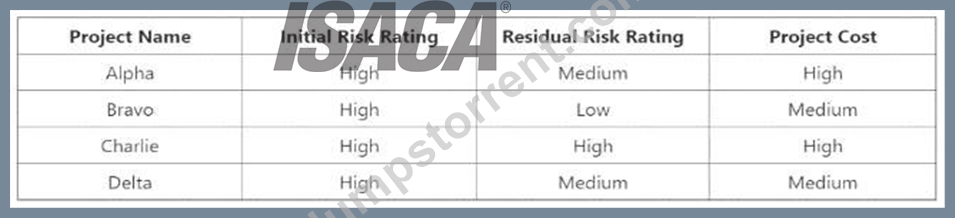
- A. Project Delta
- B. Project Alpha
- C. Project Bravo
- D. Project Charlie
Answer: D
NEW QUESTION 301
Which of the following is the GREATEST benefit of updating the risk register to include outcomes from a risk assessment?
- A. It facilitates timely risk-based decisions.
- B. It maintains evidence of compliance with risk policy.
- C. It validates the organization's risk appetite.
- D. It helps to mitigate internal and external risk factors.
Answer: A
Explanation:
Section: Volume D
NEW QUESTION 302
......
An A-list certification exam like the ISACA CRISC has a lot in store for its brave challengers. If you identify yourself as part of this daring crowd, you should pursue this certification by preparing diligently. It’s the first rule to keep in mind when beginning your venture as an ISACA candidate. So, in this post, you’ll learn the process of elimination when dealing with CRISC exam prep resources.
Who should take the CRISC exam
The ISACA Certified in Risk and Information Systems Control Consultants CRISC Exam certification is an internationally-recognized validation that identifies persons who earn it as possessing skilled as Certified in Risk and Information Systems Control. If a candidate wants significant improvement in career growth needs enhanced knowledge, skills, and talents. The ISACA Certified in Risk and Information Systems Control Consultants CRISC Exam certification provides proof of this advanced knowledge and skill. If a candidate has knowledge and skills that are required to pass the ISACA Certified in Risk and Information Systems Control Consultants CRISC Exam then he should take this exam.
Prepare For The CRISC Question Papers In Advance: https://examsboost.dumpstorrent.com/CRISC-exam-prep.html